DMZ Tour from Seoul: Tour or On Your Own? What You Can Actually Reach
Last Updated on October 17, 2026
Quick Answer
You can reach most of the Korean DMZ without a tour. Paju City sells shuttle tickets at Imjingak to the Third Tunnel, Dora Observatory and Unification Village (₩9,200 walking, ₩12,200 with the tunnel lift, as of October 2026). Bring your original passport and arrive before the 14:30 ticket cutoff. A tour suits you if you want Seoul pickup, an English guide and no deadline to manage. Panmunjom (JSA) is closed to foreign passport holders either way.
The Full Answer
Many English guides to the Korean Demilitarized Zone open with the same sentence: you cannot visit independently, so book a tour. Of the six English guides I read in October 2026, three said exactly that. They are wrong. The Third Tunnel (제3땅굴), Dora Observatory (도라전망대), Unification Village (통일촌) and the Imjingak Peace Gondola (임진각 평화곤돌라) are run by Korean public bodies and a private gondola company that sell tickets to anyone with the right document.
The reason is structural. Paju City’s booking site carries a modal on every page reading “파주DMZ 평화관광 영문 서비스는 준비중입니다” — the English service is in preparation. The only operators writing in English are tour companies, and their pages describe their own product.
I read Paju City’s DMZ Peace Tourism pages, fee table, timetable and notice board directly on 17 October 2026, plus the gondola operator’s site. Four findings change how you should plan:
- Independent is possible, at ₩9,200–12,200 for the shuttle. What you carry is the risk: a 14:30 ticket cutoff and an original passport for every person.
- Big bus tours walk the tunnel. Paju’s fee table gives groups of 30 or more arriving by their own bus a walking-only option. The tunnel lift is not on their price list.
- Mondays change everything. The Paju sites are closed, but the gondola runs.
- The tunnel lift reopened on 29 September, with new rules about who can use it.
Verdict 1: The tunnel lift is back, but not for everyone
The Third Tunnel’s shuttle lift (셔틀승강기, sold as the “monorail”) reopened on 29 September 2026, according to a Paju notice dated 23 September that I read on the Paju board. English guides still describe it as a simple ₩3,000 option, but the rules are narrower:
- It applies to individual shuttle users only.
- It runs on five departures: 9:20, 10:30, 11:30, 13:00 and 14:00, weekdays and weekends alike.
- The ticket split is 10 online and 20 on site.
- Anyone who bought an online ticket pays an extra charge on site to use the lift. The notice gives no amount. Paju’s fee table lists the lift at ₩3,000 for an adult, so that is the likely figure, but it is my reading of the fee table, not a number in the notice.
- If the lift breaks down, the departure converts to walking (Paju’s timetable).
I could not find a notice saying when the lift stopped; the only dated facts are the 23 September notice and the 29 September restart. The department’s number is 031-940-4114 if your trip depends on it.
Local tip — If you want the lift, aim for one of those five departures and expect to pay at the window as well as online. English guides that say “monorail ₩3,000 extra” are describing a fee table, not today’s rules.
Verdict 2: A big tour bus walks you down the tunnel
Paju’s fee table has two price families. Individuals on the city’s shuttle choose walking (₩9,200) or the lift (₩12,200) per adult, facility fee included. Groups of 30 or more arriving on their own bus are priced for walking only, with a ₩4,000 facility fee. The lift line does not appear for them.
Group courses run on chartered coaches (30–45 seats) on their own slot timetable. So a large coach tour descends the tunnel on foot. If you have knee problems or are bringing an older parent, ask the operator before booking whether the group is small enough to use the individual shuttle. I could not confirm how small-group operators handle this; the product pages I could read say “walk through the tunnel.”
Paju’s viewing order notice (21 August) says the visit normally runs film hall, then a walk, then the tunnel. Two English guides in my sample (Seoul Tourism Guide and Korea Experience) fold the individual shuttle’s lift fee into advice for tour customers. It does not apply to group tours.
Local tip — The tunnel is a steep, narrow, low passage. Paju’s visitor page says elderly visitors, people with blood pressure or respiratory trouble, and anyone who has been drinking may be refused, and wheelchair users may not be able to enter.
Verdict 3: Monday is when tours and shuttles diverge
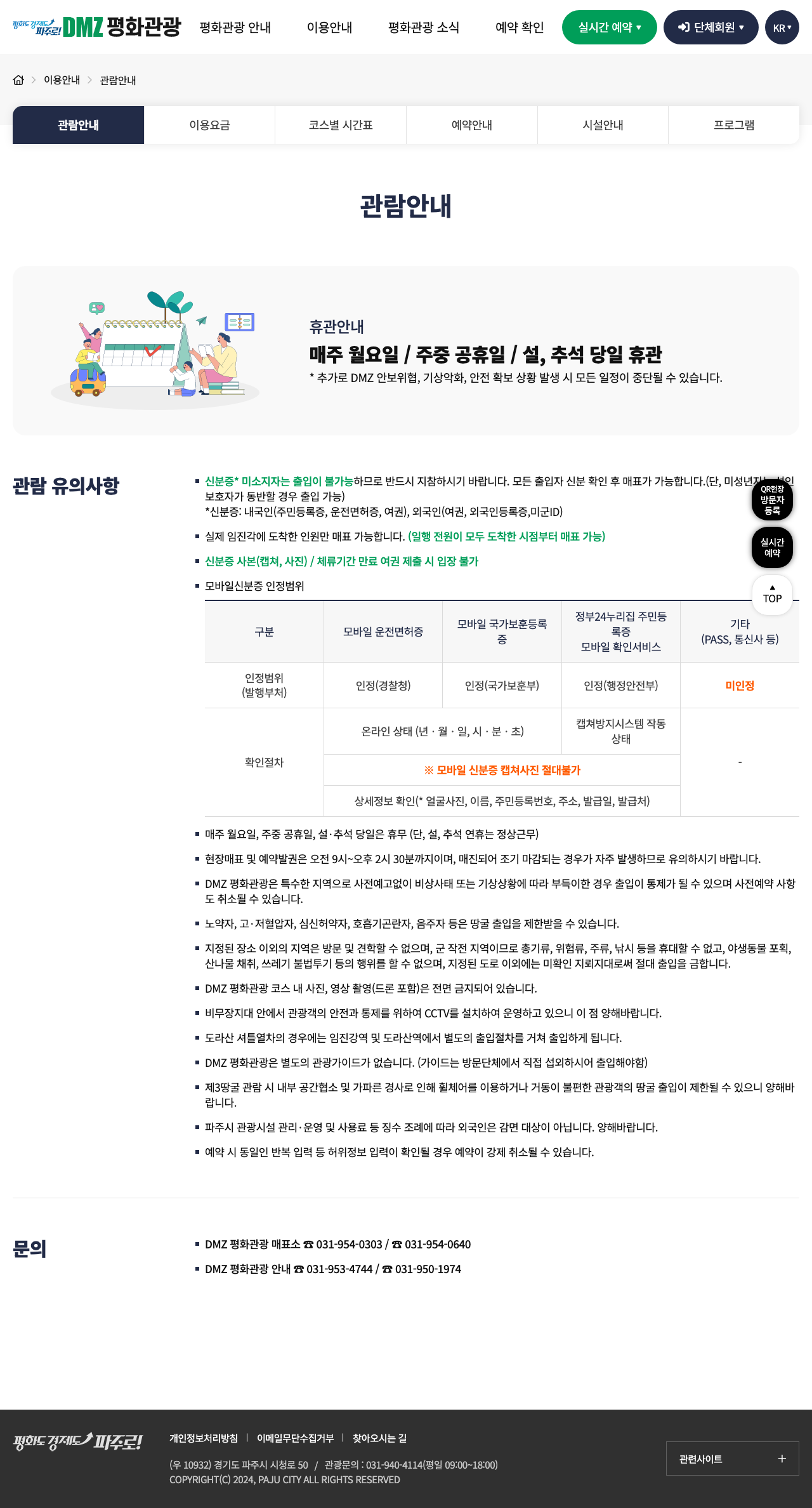
Paju DMZ Peace Tourism closes every Monday, on weekday public holidays, and on Lunar New Year’s Day and Chuseok day itself. The surrounding holiday days run normally. That covers the Third Tunnel, Dora Observatory and Unification Village.
The Peace Gondola does not follow that calendar. Its site lists it as open daily, year-round, 09:00 to 18:00 (on-site sales start at 10:00 on Mondays). Camp Greaves, the former US Army base at the far end, is closed on Mondays, so the gondola can run while its destination is shut.
The gondola does close for national safety inspections and quarterly maintenance. Recent closures I found were Monday 9 March and Monday 14 September 2026. The second is not the first Monday of the month, so do not rely on a “first Monday of March, June, September and December” rule; check the gondola’s notice page for your date.
I did not confirm what tour operators substitute on Mondays, so read the product page itself before booking a Monday departure.
Local tip — If your only free day is a Monday, the Third Tunnel and Dora Observatory are shut for everyone, tour or not. The gondola and Imjingak are what you can reach on your own.
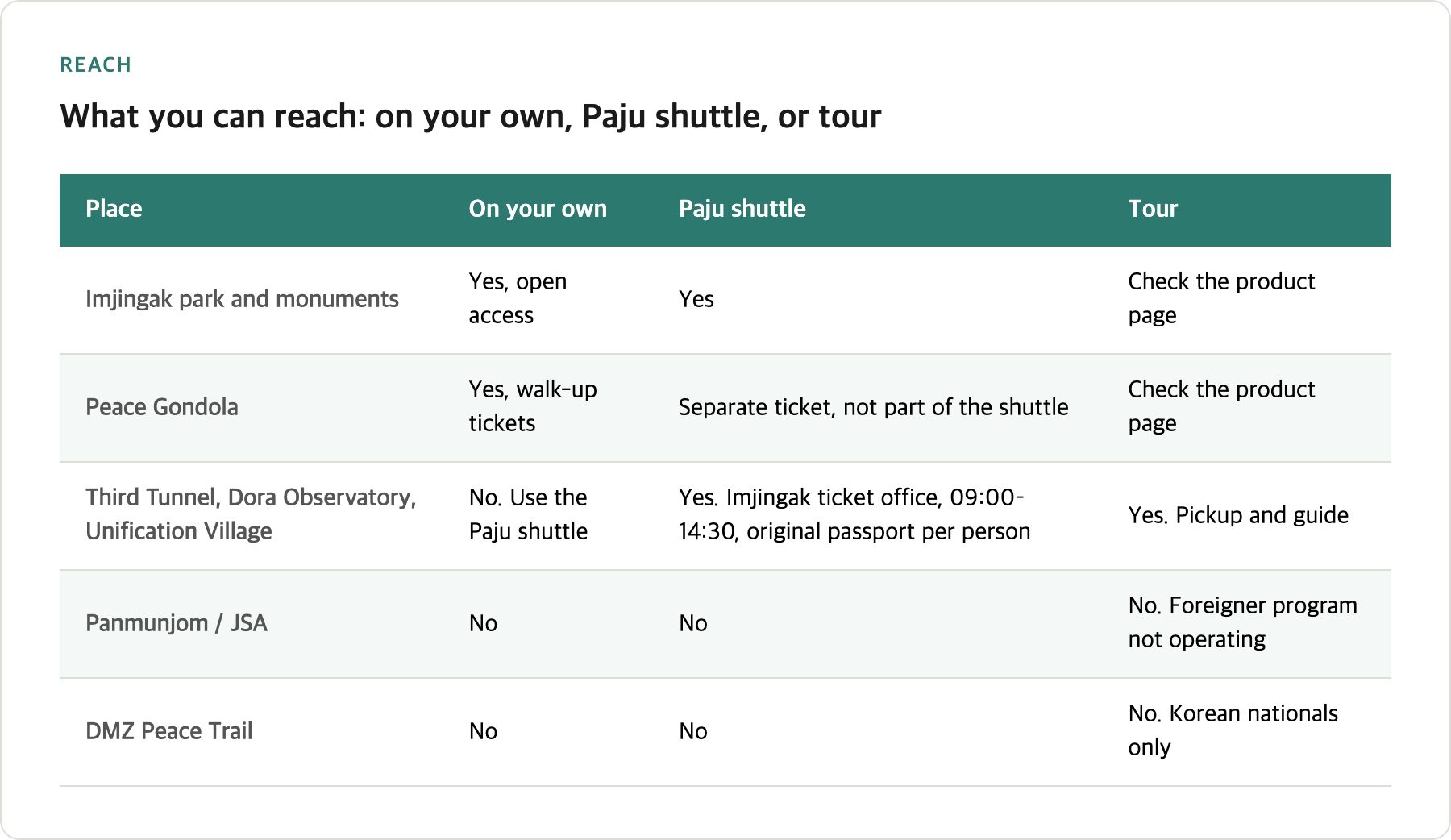
Verdict 4: What you can reach on your own, and what needs the shuttle
This is the table English guides leave out.
| Place | On your own? | How |
|---|---|---|
| Imjingak (임진각) park and monuments | Yes | Open access, outside the civilian control line |
| Peace Gondola (평화곤돌라) | Yes | Walk-up tickets, ₩12,000 adult (crystal cabin ₩15,000); one ID from the group leader plus a security pledge |
| Third Tunnel, Dora Observatory, Unification Village | Yes, via Paju shuttle only | Ticket office at Imjingak, 09:00–14:30, original passport per person |
| Panmunjom / JSA | No | Foreigner program not operating |
| DMZ Peace Trail | No | Korean nationals only |
For an individual visitor, the Paju shuttle from Imjingak is the way in, and it has no guide.
ID rules are strict. Foreign visitors need a passport, alien registration card or US military ID. A photo or screenshot of your passport is refused, as is a passport whose permitted stay has expired.
Local tip — The shuttle needs ID from every person, but the gondola’s walk-up purchase page says one representative’s ID plus a security pledge (보안서약서) is enough for the group. If someone left a passport at the hotel, the gondola is still possible and the shuttle is not.
The ticket cutoff
On-site ticketing and reservation pickup run from 09:00 to 14:30, and Paju’s page adds that departures often sell out and close early. Tickets are only issued for people who have physically arrived at Imjingak (“실제 임진각에 도착한 인원만 매표 가능”). You cannot buy for a friend still on the train.
Online booking releases only part of each shuttle. Paju’s timetable page states that individuals can reserve 14 of the 44 seats on each departure, with some departures fully bookable and the rest sold on the day. The 9:20 departure is now sold on site only (existing reservations still stand). The booking site is Korean-only, so most foreign visitors buy at the window anyway. Paju also caps daily entry to the zone at 3,000 people and 90 buses, so a crowded day can restrict sales.
Photography and video are prohibited across the whole shuttle course, drones included.
Getting to Imjingak from Seoul
The Gyeonggi Province English page says the Gyeongui Line stops at Imjingang Station, about ten minutes’ walk from Imjingak. The bus route is the 909 or 9710 to Munsan terminal, then the 058 local. I did not find a current fare for these legs, so I am not quoting one. The Seoul subway guide covers only part of the journey, and the wider transport picture shows where the metro ends. A topped-up T-money card covers transit legs. Because Google Maps transit directions in Korea are bare-bones, plan the route in Naver Map or Kakao Map and keep a working data connection.
Paju’s notice board also announces the “DMZ Peace Connect Train” (평화이음열차), run from April 2026 by the Ministry of Unification, Paju and Korail after Paju’s earlier Dora Mountain shuttle train ended in March. Its base fare is ₩39,600 (as of 2026), booked through Korail Tourism Development (1544-7755). I did not verify its itinerary or whether it is open to foreigners.
Verdict 5: Three of six English guides say you cannot go alone
I read six English DMZ pages in October 2026, blogs and tour listings (a small sample, read by searching for key terms, not a full audit):
| Claim | Pages making it | What the official pages say |
|---|---|---|
| “You cannot visit independently, book a tour” | 3 of 6 (Mile Asia, Korea Experience, Seoul Tourism Guide) | Paju sells shuttle tickets to individuals |
| Full-day tours “including JSA” | 2 of 6 (Mile Asia; Seoul Tourism Guide adds “when operational”) | The foreigner Panmunjom program is not running (my August 2026 capture) |
| Tour customers pay “monorail ₩3,000 extra” | 2 of 6 (Seoul Tourism Guide, Korea Experience) | Group price lists have no lift |
| Treats the lift as running normally | 2 of 6 (Seoul Tourism Guide, Korea Experience) | A 23 September notice announced it was restarting |
| No mention of the Monday closure or the 14:30 cutoff | 1 of 6 (Mile Asia) | Both are on Paju’s page |
| Monday closure, JSA closed and the 14:30 cutoff all correct | 1 of 6 (Earth Vagabonds) | Matches Paju |
Panmunjom: closed to foreigners, and there is one change worth knowing
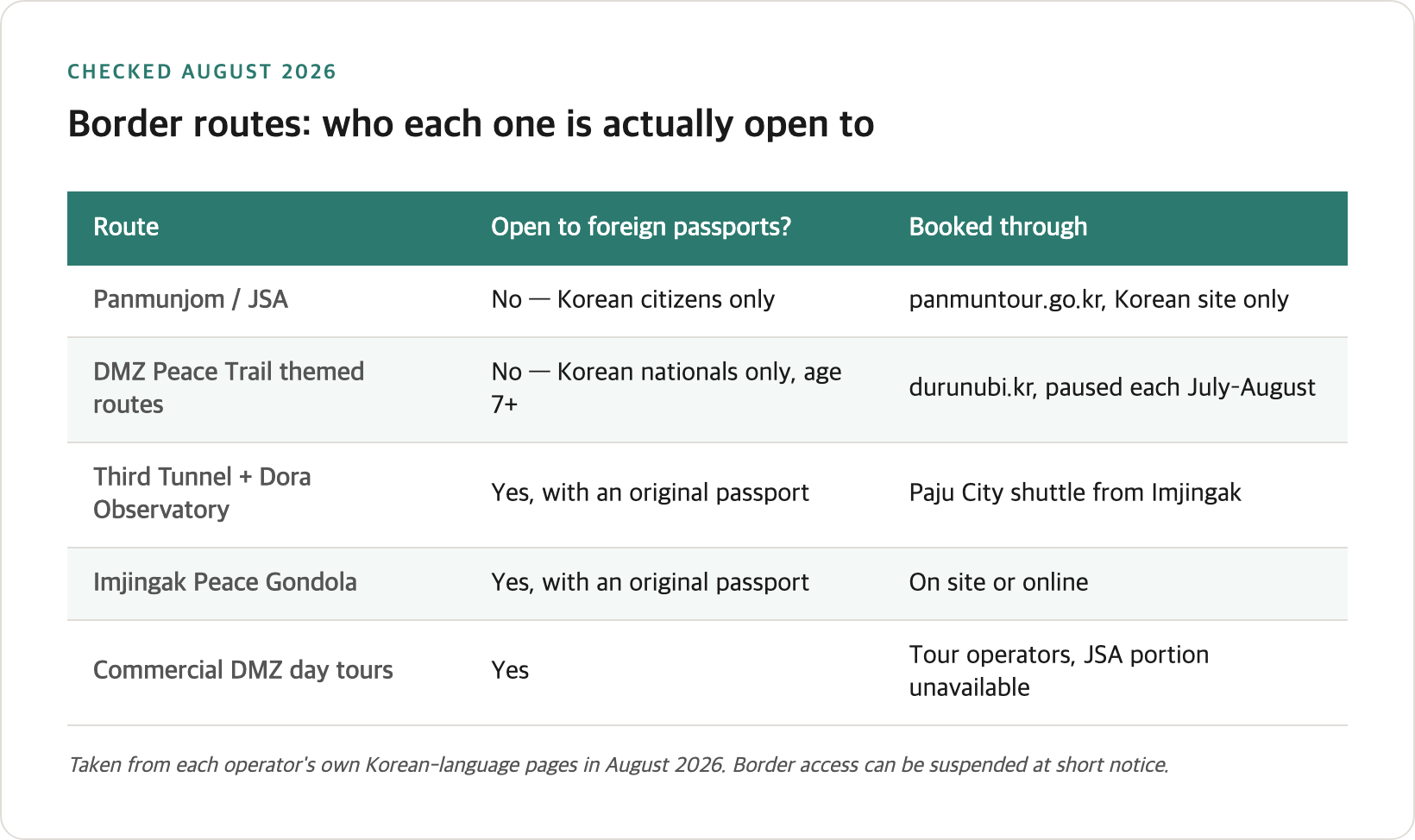
The Joint Security Area has been closed to civilian tourism since 18 July 2023. I could not open the Ministry of Unification’s English page on 17 October, so this relies on my August 2026 capture, which stated that the foreigner tour program is “currently not under operation.”
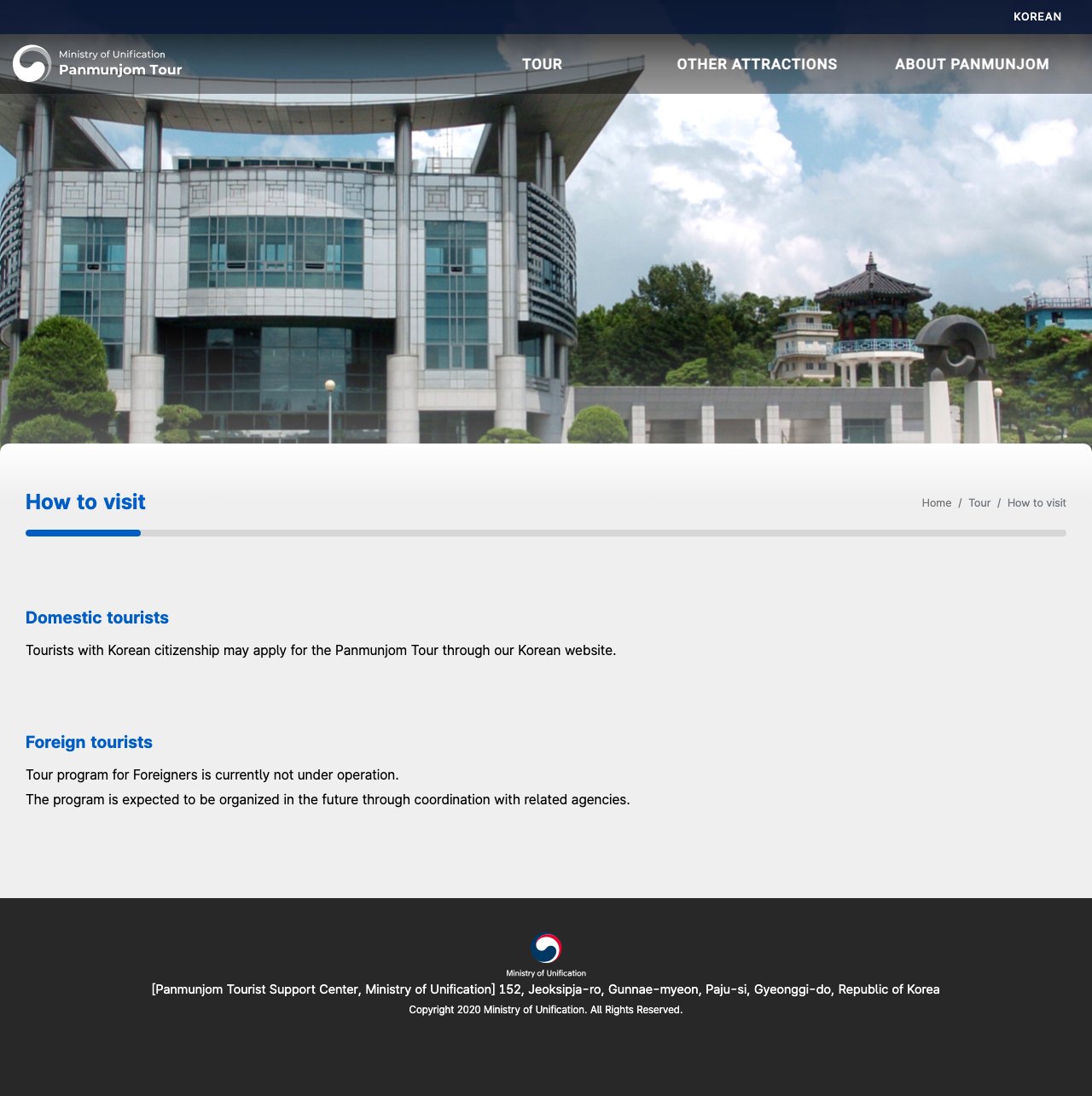
A separate Panmunjom tour runs for Korean citizens only. Read product names closely: some listings include “JSA Museum” or a “JSA” photo zone, and the gondola’s DMZ Station has a “Panmunjom photo zone” on its roof (a June 2026 gallery post). These are not Panmunjom. One operator’s listing says outright that a JSA visit is not included.
In December 2025 the UN Command told NK News it had redesigned the JSA orientation so visitors no longer walk onto Conference Row, going to the top of Freedom House instead. If your picture of the DMZ is standing inside the blue hut, adjust it before booking anything.
The DMZ Peace Trail (DMZ 평화의 길) is also Korean nationals only (age 7 and over, per the Durunubi portal), so it is not a foreigner alternative either.
So: which one is for you?
Go on your own if you can be at Imjingak before about 13:00, you are comfortable with a Korean-only booking site and regional buses, and you do not need a guide. The shuttle costs ₩9,200–12,200 per adult (as of October 2026), plus ₩12,000 if you add the gondola, plus transit. What a week in Korea actually costs puts this in the context of a full trip. Bring cash as well as a card, and note that foreign cards are not accepted at every Korean ATM.
Take a tour if you want pickup from central Seoul, an English-speaking guide, and someone else handling the ticket deadline and the paperwork. A packaged day trip covering the Third Tunnel and the suspension bridge is one way to do it. It reaches the same sites as the shuttle and handles the logistics for you.
Our Nami Island day trip guide compares tour and self-guided options the same way.
Whether you need a visa or a K-ETA is decided by your nationality, but your passport must be valid and unexpired at the Imjingak gate.
What You Need to Know
- Panmunjom is not open to foreign passport holders. No reopening date was published as of August 2026.
- The Third Tunnel, Dora Observatory and Unification Village are open via Paju’s shuttle to anyone with an original passport.
- The tunnel lift restarted on 29 September for individual shuttle users only, on five departures.
- Large groups (30+ on their own bus) are priced for walking only.
- The ticket window is 09:00–14:30 and can close early; daily caps (3,000 people, 90 buses) can limit sales.
- Mondays: Paju sites and Camp Greaves closed; the gondola runs.
- No photography along the shuttle course, drones included.
Practical Tips
-
Be at the Imjingak ticket office before noon. The window closes at 14:30 and often sells out earlier; an early departure leaves margin for the return trip.
-
Bring the original passport for every person. Copies and expired stays are refused.
-
Check dmz.paju.go.kr the night before. Same-day closures are posted in Korean only; browser translation is enough.
-
Decide between the lift and walking before you queue. The lift slots are limited, and the walking route is a steep descent and climb.
-
Treat the gondola as a separate trip, with its own tickets, hours and closure days.
-
Do not pay a premium for a JSA itinerary. Ask the operator in writing whether Panmunjom is included.
-
Pair it with an indoor day. A DMZ morning takes most of the daylight; the National Museum of Korea or a jjimjilbang makes a good second half.
Frequently Asked Questions
Can I visit the DMZ without a tour?
Yes, for the main sites. Paju City’s shuttle runs from Imjingak to the Third Tunnel, Dora Observatory and Unification Village, and tickets are sold on site to anyone with an original passport. Adult fares are ₩9,200 walking or ₩12,200 with the lift (as of October 2026). The Joint Security Area is not open to foreign visitors at all.
Is Panmunjom or the JSA open to tourists in 2026?
Not to foreign passport holders. The Ministry of Unification’s English page, as I captured it in August 2026, states the foreigner tour program is not in operation. A separate program for Korean citizens runs on set days.
What time does DMZ Peace Tourism stop selling tickets?
On-site ticketing and reservation pickup run from 09:00 to 14:30. Paju says departures often sell out and close earlier.
What ID do I need?
An original passport, alien registration card or US military ID. Photos and screenshots are refused, as is a passport with an expired stay. Everyone in the party must be present before tickets are issued.
Is the DMZ open on Mondays?
The Paju sites (Third Tunnel, Dora Observatory, Unification Village) are closed every Monday and on weekday public holidays. The Peace Gondola runs on Mondays, but Camp Greaves at the far end is closed.
Do large DMZ tour buses use the tunnel lift?
Paju’s fee table lists groups of 30 or more arriving on their own bus under walking-only pricing, so large coach tours walk the tunnel. For smaller groups, I could not confirm, so ask the operator.
Can I take photos at the DMZ?
Not on the Paju shuttle course; photography and video, drones included, are prohibited throughout. The gondola bans photography near the perimeter fence and military installations.
Related Questions
- Nami Island Day Trip from Seoul: Tour or On Your Own?
- Gyeongbokgung: Free Entry Days and When It’s Closed
- Changdeokgung Secret Garden: The Timed-Entry Rule Nobody Explains
- Jjimjilbang: What First-Timers Get Wrong About Time Limits