Driving in Korea on a Foreign Licence — Where the English Guides Go Wrong
Last Updated on September 14, 2026
Quick Answer
Driving in Korea on a foreign licence is legal for one year from the date you enter the country — but the law recognises more routes than most English guides list. Road Traffic Act Article 96(1) names four: the 1949 Geneva permit, the 1968 Vienna permit, and two mutual-recognition routes. Rental counters ask for less than the law allows, which is where the confusion starts.
The Full Answer
Almost every English-language page about driving in Korea gives one instruction: get an International Driving Permit issued under the 1949 Geneva Convention before you fly. For most visitors that produces the right outcome, so it rarely gets questioned. It is also narrower than what Korean law says, and for a small group of travellers it produces the wrong answer entirely.
I pulled the current text of the Road Traffic Act (도로교통법) from law.go.kr on September 14, 2026 and checked the version stamp rather than trusting a cached copy — the text in force carries an enforcement date of July 1, 2026. Article 96(1) lists four separate legal bases for driving here on a foreign document. The 1949 Geneva Convention is the first. The 1968 Vienna Convention is the second, on equal footing, in its own numbered clause.
That detail is the reason this guide exists, and it is not the only place where the Korean and English versions of the same information part ways. The pattern repeats: Korea’s own agencies and Korea’s own rental companies publish one thing in Korean and something different, or something missing, in English. So what follows is a set of side-by-side comparisons rather than a country-by-country eligibility table — the eligibility tables already exist in English, and they are not where the errors are.
Whether you want a car is a different question from whether you are allowed to drive one. Our Jeju budget guide covers what a rental costs once insurance, fuel and parking are in; this one covers whether you can legally get the keys.
What the Road Traffic Act Actually Lists
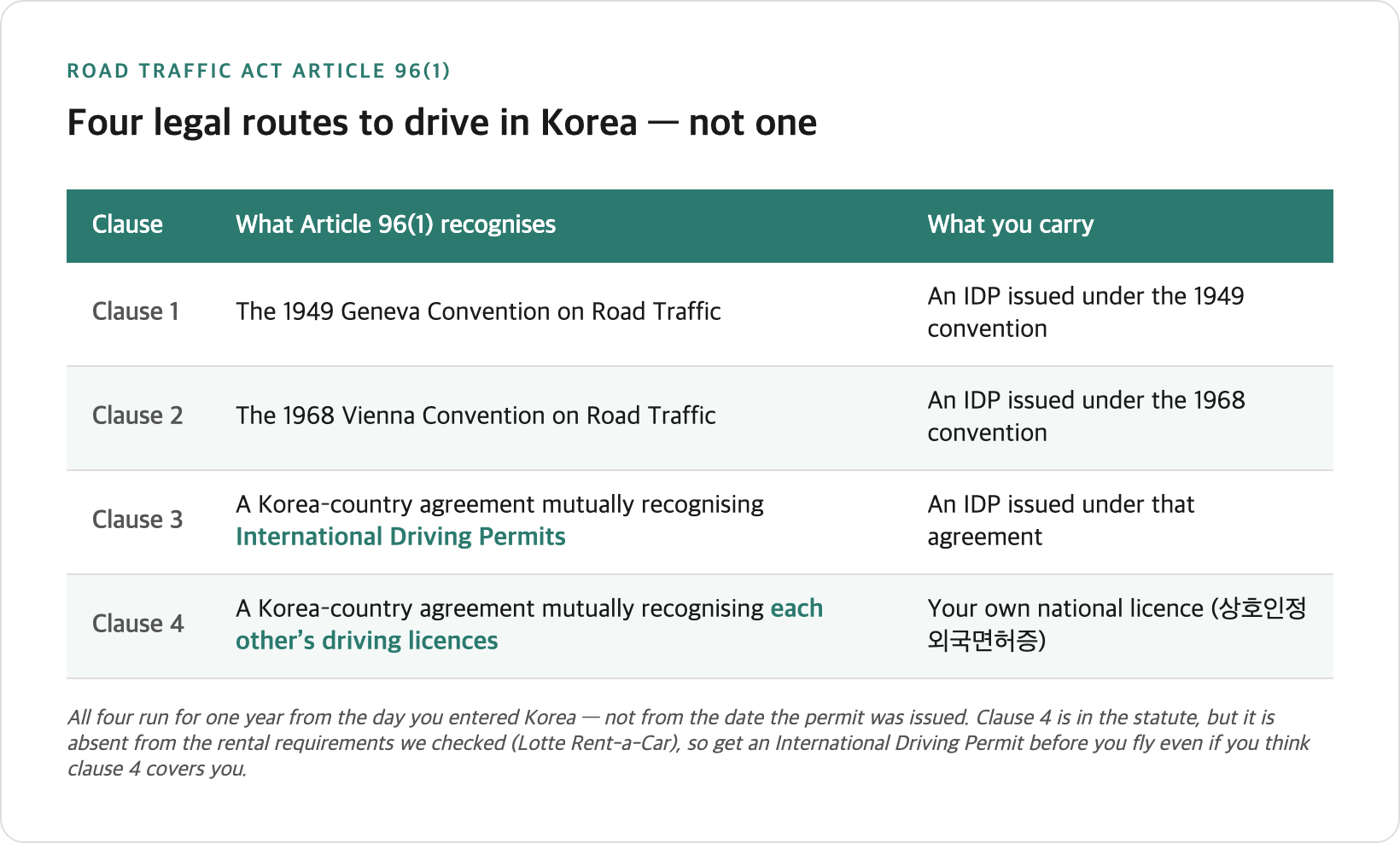
Article 96(1) covers two kinds of document. The first three clauses cover the International Driving Permit (국제운전면허증). The fourth covers something else entirely: a foreign driving licence itself, recognised directly. Korea’s own plain-language legal information service lays the same ground out in Korean on a single page — the conventions, the mutual-recognition routes, the one-year window and the rental-car exception.
| Route | What Article 96(1) says | What you carry |
|---|---|---|
| Clause 1 | The 1949 Geneva Convention on Road Traffic | An IDP issued under the 1949 convention |
| Clause 2 | The 1968 Vienna Convention on Road Traffic | An IDP issued under the 1968 convention |
| Clause 3 | A treaty or agreement between Korea and another country mutually recognising International Driving Permits | An IDP issued under that agreement |
| Clause 4 | A treaty or agreement between Korea and another country mutually recognising each other’s driving licences | Your own national licence (상호인정외국면허증) |
Three things apply to all four routes equally.
The clock is one year from entry, not from issue. The wording is “국내에 입국한 날부터 1년” — one year from the day you entered the country. Your permit’s own printed validity is a separate limit that also has to hold.
You can drive only the vehicle classes written on the document. A permit stamped for cars does not extend to a motorcycle or a van.
Commercial driving is out, with one exception that matters. Article 96(2) bars foreign-permit holders from driving commercial passenger or freight vehicles — then adds a proviso: this does not apply to a vehicle rented from a licensed rental business. Rental cars are registered as commercial vehicles in Korea (대여사업용 자동차), so without that proviso, added in the October 2021 amendment, every foreign visitor in a rental car would be outside the law.
Local tip — The one-year window runs from the day you entered Korea, not from the day your permit was issued or the day you pick up the car. A permit issued eighteen months ago with six months of validity left still works; a permit issued last week does not extend a stay that began fourteen months ago. Korean rental-industry guidance routinely tells staff to check the passport’s entry record to establish that date — English guides describe the passport as an identity document only. We could not confirm how counters handle travellers who entered through automated immigration gates without a physical stamp, so ask when you book if that applies to you.
“Korea Only Takes the 1949 Geneva Permit” — Where That Comes From
This is the most repeated claim in English coverage of driving in Korea, and it is stated as a restriction rather than as advice.
Holafly’s guide, published in January 2026 and sitting second in the English results for driving in korea, says Korea “only accepts international permits issued under the 1949 Geneva Convention.” Google’s AI Overview for UK-specific queries says Korea “specifically requires the 1949 Geneva Convention IDP.”
Clause 2 of Article 96(1) says otherwise in the current statute. And Lotte Rent-a-Car’s own English FAQ — the country’s largest operator, and a page that ranks in the top ten for these queries — states the condition as “Nations that are part of the Geneva or Vienna Convention.” The company’s English page and the statute agree. The travel guides are the outlier.
One point of fairness. The UK government’s page tells British drivers which permit to obtain for Korea and names the 1949 one. That is correct guidance for a British driver, because the UK issues 1949 permits and Korea accepts them. It is not a statement that Korea rejects everything else. The error appears when that guidance gets summarised into a claim about what Korea recognises.
Local tip — Article 96(1) of the Road Traffic Act lists the 1968 Vienna Convention as a separate and equal basis alongside the 1949 Geneva Convention. This matters most if you are German or Swiss. I read the UN Treaty Collection’s participant tables for both conventions directly rather than through a summary: Germany does not appear in the 1949 Geneva participant table at all, and Switzerland signed the 1949 convention but its ratification column is blank. Both ratified the 1968 convention — Germany in August 1978, Switzerland in December 1991. Neither country appears in the Geneva list that Korea’s own English-language legal information site publishes. A German driver who follows the “1949 only” line in English guides would conclude they cannot legally drive in Korea. Under the statute, they can.
The Treaty Table and the Statute Are Two Different Questions
There is a reason careful writers still get this wrong, and it also tells you how to check similar claims yourself.
Korea acceded to the 1949 Geneva Convention on June 14, 1971. Korea is not a ratifying party to the 1968 Vienna Convention. Looking only at the treaty tables, “Korea is a Geneva country” is a correct sentence — and the conclusion “therefore Korea accepts only Geneva permits” follows naturally, and is wrong.
Domestic law closes the gap. A country can choose, in its own statute, to recognise documents issued under a convention it has not itself ratified, and Korea has done that in clause 2. Treaty membership tells you which permits Korea’s own citizens can use abroad. The Road Traffic Act tells you which permits Korea accepts at home. Two different lists, for two different purposes.
For German and Swiss drivers this is not a technicality. It is the difference between renting a car and taking the train.
The Fourth Route: Your Own Licence, With No Permit
Clause 4 is the part of Article 96 that English-language sources describe least accurately, and the AI-generated answers get it backwards.
Ask Google whether a tourist can drive in Korea on a national licence under a mutual-recognition agreement, and the AI Overview answers that mutual recognition “applies to long-term resident visa holders converting to a Korean license, not short-term tourists.” Confident, and the opposite of what the amendment that created the clause says it was for.
I read the Ministry of Government Legislation’s published statement of reasons for the October 19, 2021 amendment (Act No. 18491, in force April 20, 2022), in Korean. The stated purpose: “외국에서 취득한 외국면허증만으로도 국내에서 운전할 수 있도록 근거를 마련” — to establish a basis for driving domestically on a foreign licence alone. The summary of main provisions adds that the new 상호인정외국면허증 was designed to allow driving “for one year within the country, the same as the existing International Driving Permit.”
So the route exists, it was built deliberately, and it carries the same one-year window as an IDP.
Local tip — Since April 2022 the Road Traffic Act has had a fourth route: your own national licence, no International Driving Permit, one year from entry, where Korea and your country have a licence mutual-recognition agreement. English-language sources describe this as a residents-only mechanism for exchanging a licence; the amendment’s own published rationale says it was created so that a foreign licence alone would work. What nobody publishes cleanly — including Korea’s agencies — is a definitive list of which countries clause 4 covers. The only public list we found sits on the government’s plain-language legal information site, the Korean and English versions of that page do not count the same number of entries, and the English version cites the foreign ministry’s outbound travel-safety site as its source, which is the list for Koreans driving abroad. We could not resolve it from primary sources. Which is why, in practice, you still bring the permit — but now you know why the counter’s answer and the statute’s answer differ.
Treat clause 4 as context, not as a plan. If you arrive without an IDP expecting your national licence to be enough, the person deciding is a rental agent with a company checklist, not a court reading the statute.
What the Rental Counter Actually Asks For
Lotte Rent-a-Car is the largest operator in Korea and publishes its requirements in English. This is what its English FAQ sets out, as of September 2026.
| Requirement | What Lotte specifies |
|---|---|
| Identity | Passport — for the renter and every listed driver |
| Licence | Original IDP — for the renter and every listed driver, not a copy |
| Issuing country | A party to the Geneva or Vienna Convention |
| Minimum age | 21 (as of 2026) |
| Vehicle class | Class B or above for up to 9 seats; Class D or above for up to 11 seats |
| Validity | Valid for one year from the driver’s arrival in Korea, and the rental period must sit inside the permit’s own validity |
| Payment | Debit or credit card |
| Not accepted | Permits from private issuers; documents branded “EU International Driver’s License” |
Two things stand out. The clause 4 route is absent — nowhere in Lotte’s English materials is there a path for a driver presenting a national licence under a mutual-recognition agreement. The law has that route; this counter does not offer it. And the class stamp is a real gate: Lotte tells customers to verify eligibility from the stamps on the permit itself, so a mismatch surfaces at the counter rather than at booking.
One limit on all of this — we checked Lotte. SK Rent-a-Car and the smaller Jeju operators run JavaScript-rendered sites we could not read directly, so their document requirements and age rules are unconfirmed. Do not assume the Lotte checklist is the industry checklist.
Hi-Pass: The Same Company Says Two Different Things
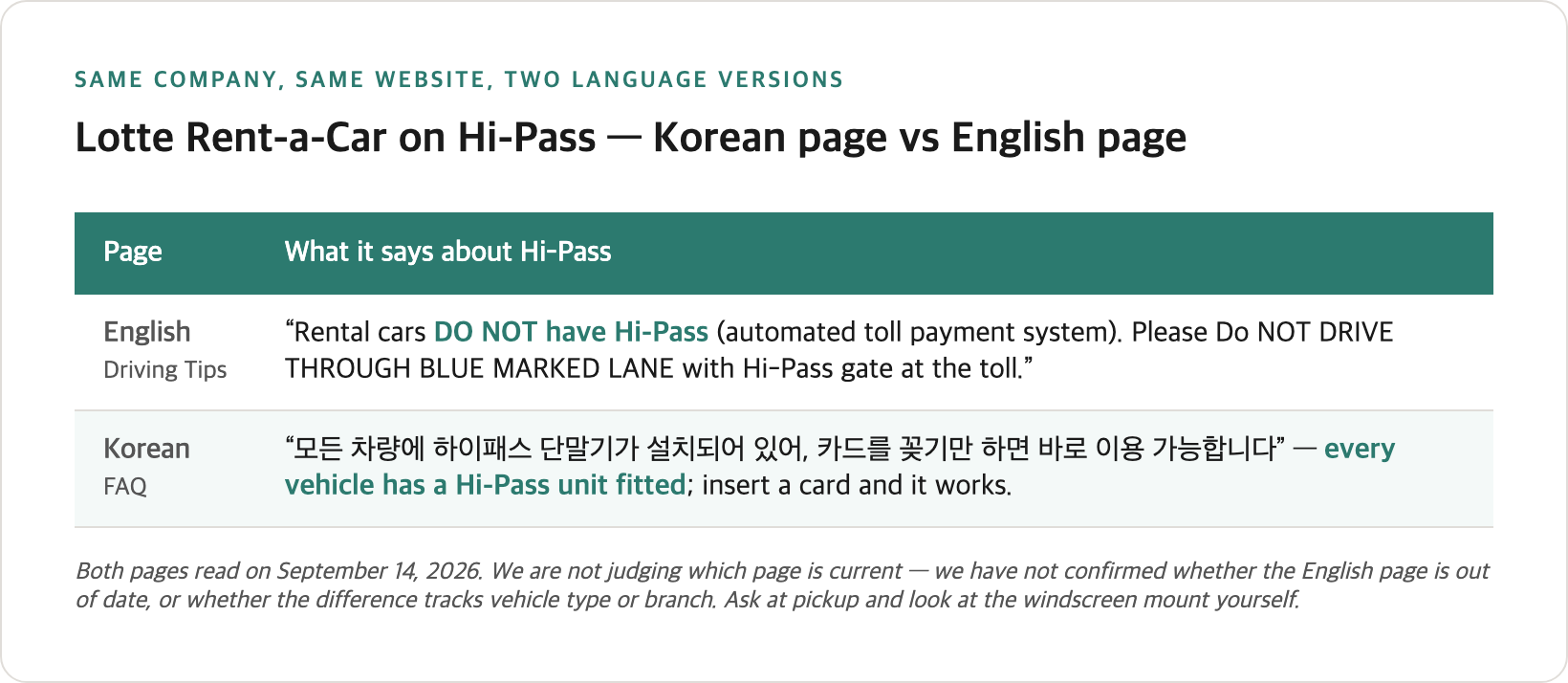
This is the clearest example of the pattern, and you can verify it yourself in about ninety seconds. I opened Lotte Rent-a-Car’s Korean FAQ and its English driving-tips page side by side on September 14, 2026. They say opposite things.
| What the page says | |
|---|---|
| English — Driving Tips | “Rental cars DO NOT have Hi-Pass (automated toll payment system). Please Do NOT DRIVE THROUGH BLUE MARKED LANE with Hi-Pass gate at the toll.” |
| Korean — FAQ | “롯데렌터카에서는 모든 차량에 하이패스 단말기가 설치되어 있어, 카드를 꽂기만 하면 바로 이용 가능합니다” — every vehicle has a Hi-Pass unit fitted; insert a card and it works |
Local tip — Lotte’s English driving-tips page tells you its rental cars have no Hi-Pass transponder and instructs you to avoid the blue-marked lanes at toll gates. Its Korean FAQ, on the same website, says every Lotte vehicle has a Hi-Pass unit installed and that branches sell a rechargeable card if you do not have one. We are not judging which page is current — we have not confirmed whether the English page is simply out of date, or whether the difference tracks vehicle type or branch. What we can say is that the company contradicts itself across its two language versions, so ask at pickup and look at the windscreen mount yourself rather than trusting either page.
Two caveats on scope. This concerns expressway toll gates on the mainland; we have not verified how it applies on Jeju, so do not carry the conclusion to an island rental. And the Korean FAQ adds friction that English sources omit entirely: refunding the balance on an unregistered rechargeable Hi-Pass card requires a visit to an SM Hi-Plus branch office, which is not something you can do at the airport on your way out.
What Happens If You Get It Wrong
The Act distinguishes between not having the right to drive and not having the paper on you.
Driving without a valid permit — including an expired one, or driving during a suspension — falls under Article 152(1): imprisonment of up to one year, or a fine of up to ₩3,000,000 (as of 2026).
Failing to carry or present the permit when you do hold a valid one is the lesser matter, under Article 156(1): a fine, detention or minor fine of up to ₩200,000 (as of 2026).
Article 97 is the one most travellers meet only through insurance paperwork. A metropolitan or provincial police commissioner can bar a foreign-permit holder from driving for up to one year, on grounds that include causing an accident through intent or negligence. The document is surrendered and returned on application when the period ends — or when you leave the country during it.
Age Limits Come From the Industry, Not the Act
The commonly quoted figures — 21 for an ordinary car, higher for larger vehicles, a year of licence-holding experience — are rental-company policy rather than statutory requirements. We checked the full text of the Passenger Transport Service Act (여객자동차 운수사업법) and its enforcement rules: the age of 21 does not appear in either.
This is one place where English-language coverage is already correct. Remitly’s guide states plainly that the age limits come from the rental industry and can differ from the Road Traffic Act’s rules. We are confirming it rather than correcting it.
The consequence is the same either way: the age rule that binds you is the one in the contract you sign, and it varies by company and vehicle class. Check it at booking.
What You Need to Know
-
The four routes are not interchangeable at the counter. The statute recognises four; Lotte offers two. Plan around the counter’s list and keep the statute as background.
-
The year runs from your entry stamp. If your stay involves a break and a re-entry, we could not confirm whether the year restarts — Korean and English sources both came up empty, and we found no published legal interpretation. Do not assume it resets.
-
Google Maps cannot give you driving directions in Korea. This is a legal restriction on exporting map data, not a bug, and it applies countrywide. Naver Map or KakaoMap — or the vehicle’s built-in navigation — is not optional if you are driving.
-
Your foreign card may not behave as expected. The deposit and the rental are card transactions, and Korea has a broader pattern of foreign cards being refused where visitors do not expect it. Know where you can withdraw cash before you need to.
-
Rental cars are legal because of a proviso, not a general rule. Article 96(2) bars commercial driving and then carves out rented vehicles. That carve-out is the whole basis of tourist car rental here.
-
Permits are issued at home, not here. An IDP comes from the authority that issued your licence — typically an automobile association or a post office. Every issuer we checked is in the licence-holder’s own country, and we did not confirm any route to getting one in Korea on a foreign licence. Arrange it before you travel.
Practical Tips
-
Get the permit before you fly, even if you think clause 4 covers you. The mutual-recognition route exists in law and is absent from the counter’s checklist. The permit ends the argument before it starts.
-
Check the class stamps on the permit, not just its expiry. Lotte asks customers to verify eligibility from the stamps. If you are booking anything larger than a standard car, confirm the class requirement at booking.
-
Bring the original of everything, for every driver. Passport and original permit, for the renter and each additional driver. Copies and photographs are not accepted, and an undocumented second driver is not covered.
-
Ask about Hi-Pass at pickup and look at the windscreen. The operator’s own pages disagree about whether the transponder is fitted. Thirty seconds of looking settles it for your specific car.
-
Install a Korean navigation app before you land. Set the language to English while you are on hotel wifi rather than in a car park. This is the single most avoidable problem on the list.
-
Count your year from the entry stamp, not the licence. If you have been in Korea for close to twelve months, the permit’s own validity is not the binding constraint — the entry date is.
-
Decide whether you want to drive at all. On Jeju the bus network reaches most major sights and the three- and five-day itineraries work without a car. Elsewhere, intercity trains, the Seoul subway and taxis cover most of what visitors do — read the wider transport picture before committing to a rental.
Frequently Asked Questions
How do I drive in Korea as a foreigner?
You need a document that Road Traffic Act Article 96(1) recognises, usable for one year from the day you entered Korea. In practice that means an International Driving Permit issued in your home country before you travel, carried alongside your national licence and passport. Rental companies ask for the original permit from every person who will drive, not only the person paying, and the vehicle classes endorsed on it limit what you can rent.
Can I drive in Korea with a US licence?
Not on its own, in practical terms. What the United States issues and Korea recognises is the 1949 Geneva Convention International Driving Permit, obtained from an automobile association before you travel. Carry both — the permit is not valid without the licence it was issued against. Korea’s legal information service does publish a list of US states covered by licence mutual-recognition arrangements, but Lotte’s published requirements do not offer that route — and we were not able to check the other operators.
Do I need an International Driving Permit to rent a car in Korea?
Yes at Lotte Rent-a-Car, which states that all customers must present a valid passport and an original permit. The Road Traffic Act is broader — it also recognises foreign licences directly under mutual-recognition agreements — but that fourth route appears nowhere in the company’s published requirements. We could not check SK Rent-a-Car or the smaller Jeju operators, so treat the permit as required and confirm with your company.
Does Korea accept the 1968 Vienna Convention permit, or only the 1949 Geneva one?
Both. Article 96(1) lists the 1949 Geneva Convention in clause 1 and the 1968 Vienna Convention in clause 2, as separate and equal bases. Lotte Rent-a-Car’s English FAQ states the same thing, specifying nations party to the “Geneva or Vienna” Convention. The widely repeated claim that Korea accepts only the 1949 permit is not what the statute says, and it matters for German and Swiss drivers in particular, since neither country is a party to the 1949 convention.
What age do you have to be to rent a car in South Korea?
21 at Lotte Rent-a-Car (as of 2026). This is a company rule rather than a legal requirement — we checked the Passenger Transport Service Act and its enforcement rules and found no minimum age of 21 in either text. Higher minimums are commonly quoted for larger vehicles, and some companies also require a period of licence-holding experience. Because these are contractual rather than statutory, they vary between operators, so confirm the figure with the company you are booking with.
How long can I drive in Korea on a foreign permit, and when does the year start?
One year from the day you entered Korea — not from the date the permit was issued, and not from the date you collect the car. The statutory wording is “one year from the day of entry into the country,” and Korean rental guidance tells staff to establish that date from the passport’s entry record. Your permit’s printed validity is a second, independent limit: if it expires in four months, that is your window. Whether leaving and re-entering restarts the year is something we could not confirm from any primary source, so do not plan around it.
Do Korean rental cars have Hi-Pass for tolls?
Lotte Rent-a-Car answers differently in Korean and in English. Its English driving-tips page says rental cars do not have Hi-Pass and tells drivers to avoid the blue-marked lanes; its Korean FAQ says every Lotte vehicle has a unit fitted and that branches sell rechargeable cards. We have not determined which is current, or whether the difference tracks vehicle type or branch. Check the windscreen mount at pickup and ask the agent. Refunding the balance on an unregistered card requires a visit to an SM Hi-Plus branch — worth knowing before you buy one.
Related Questions
- Getting Around Korea: The Transport Guide That Connects the Details
- Why Google Maps Doesn’t Work in Korea — and What to Use Instead
- Visiting Jeju Without a Car: Buses, Fares and the Transfer Rule