Busan to Fukuoka Ferry: The Check-In Window English Guides Get Wrong
Quick Answer
One ship runs Busan to Fukuoka: the New Camellia (뉴카멜리아), an overnight car ferry leaving Busan at 22:30 and starting disembarkation at Hakata at 07:30. Check-in closes at 18:30 — four hours before departure, not the 60–90 minutes English booking sites quote. Economy costs ₩144,000 one-way including surcharges (as of August 2026).
The Full Answer
The Busan–Fukuoka crossing is the shortest international sea route out of Korea, and for a few years it had two operators: the New Camellia overnight ferry and JR Kyushu’s Queen Beetle hydrofoil, which did it in under four hours. The Queen Beetle is gone. One overnight ship is what’s left.
That leaves one timetable, one fare table and one set of rules — which ought to make it simple. It isn’t, because the operator publishes those rules across three websites in three languages and the three don’t agree. The Japanese site has the current schedule and surcharges. The Korean site has the current base fares but surcharge figures superseded in July 2026. The legacy Korean site, still live, carries a 2023 fare table. The English site — the one an English speaker finds first — has a baggage page that reads, in full, under contstruction ,,.
So the failure mode here isn’t finding a ferry. It’s turning up at the right hour with the right cash, having read a page that was accurate three years ago.
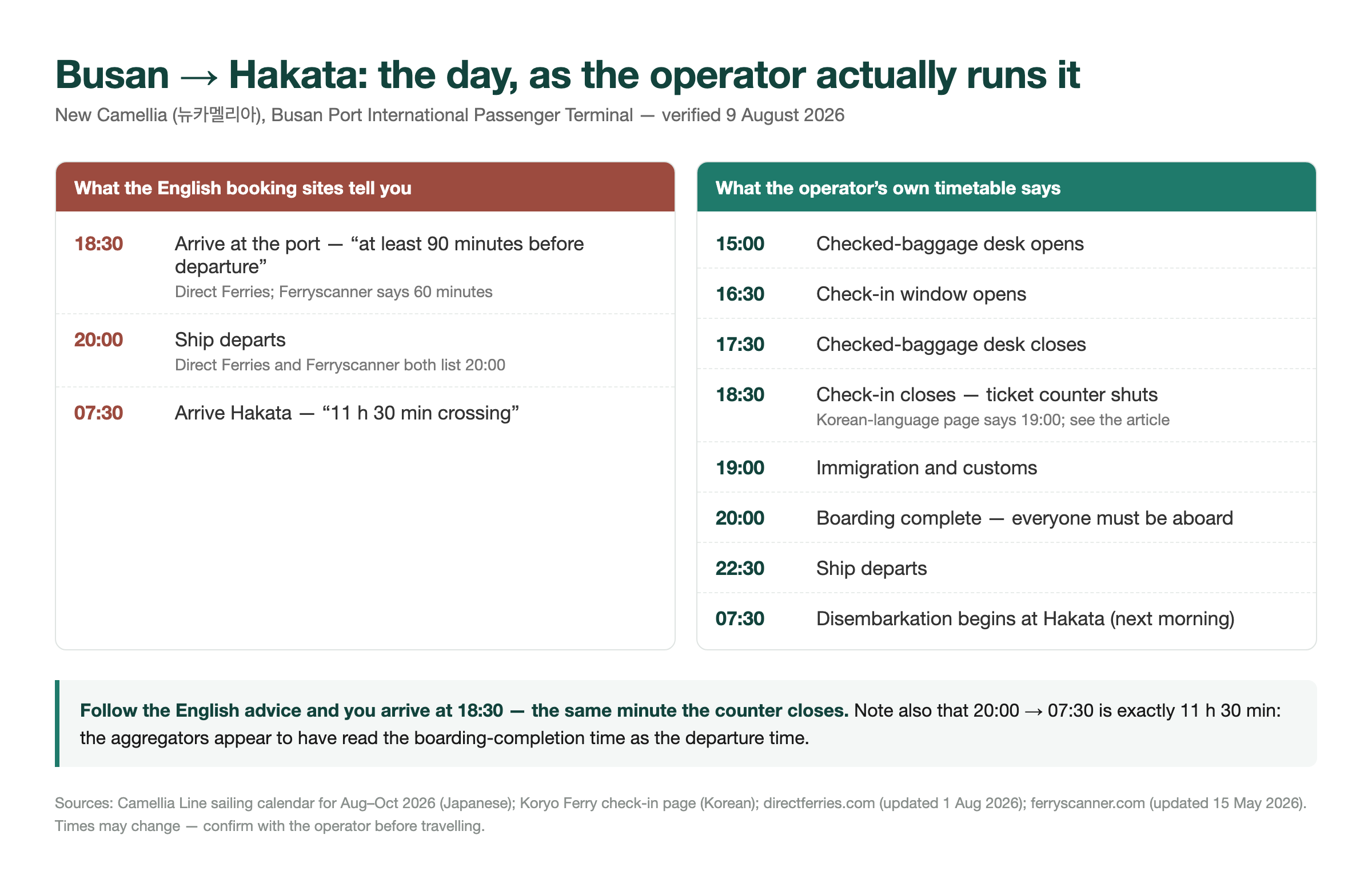
Photo by BUY Camera on Pexels
The check-in window: three official times, and which one to trust
This is the most expensive detail on the route, and every English page I checked has it wrong.
Direct Ferries tells you to “arrive at least 90 minutes before departure.” Ferryscanner says 60 minutes. Both list the Busan departure as 20:00. Follow either and you reach the terminal between 18:00 and 19:00.
The operator’s Japanese sailing calendar, updated monthly, gives the Busan-to-Hakata line as check-in 16:30–18:30, boarding complete 20:00, departure 22:30, disembarkation at 07:30 the next morning. The checked-baggage desk runs 15:00–17:30, earlier still.
Where does 20:00 come from? It is the boarding-completion time — and 20:00 to 07:30 is exactly eleven hours thirty minutes, the crossing duration Direct Ferries publishes. The aggregators appear to have read the boarding deadline as the sailing time and measured the crossing from there.
The operator’s own channels are not consistent either:
| Source | Language | Ticket counter closes | Departure |
|---|---|---|---|
| Sailing calendar, Aug–Oct 2026 | Japanese | 18:30 | 22:30 |
| Legacy fare page, koreaferry.kr | Korean | 18:30 | 22:30 |
| Check-in page, koreaferry.com | Korean | 19:00 | 22:30 |
| Direct Ferries | English | “90 minutes before” | 20:00 |
| Ferryscanner | English | “60 minutes before” | 20:00 |
Two of the three official channels say the counter shuts at 18:30; one says 19:00. Both Korean pages then put immigration and boarding at 19:00–19:40. The 18:30 figure is the one that fits the rest of the day — the baggage desk closes at 17:30, an hour before it.
Local tip — Treat 18:30 as the hard deadline and aim to be at the Busan counter between 16:30 and 17:00. That is roughly four hours before the ship sails, and it is the only arrival time that works whether or not you have a bag to check. Every English booking site on this route quotes 60–90 minutes, which would put you at the terminal after the counter has closed. Source: Camellia Line sailing calendar for August–October 2026 (Japanese) and Koryo Ferry’s check-in page, both checked 9 August 2026.
The trade-off is real: board at 20:00 and you sit on a docked ship for two and a half hours before it moves. The compensation is the arrival — 07:30 at Hakata gives you a full day in Fukuoka, which is why the Busan-departure direction is the more useful one. The Hakata-to-Busan leg runs 12:30 to 18:30 and costs you the day.
The ferry does not run every day
Direct Ferries says six sailings a week. Ferryscanner says one. A Social Nomad — otherwise the most accurate English page on this route — says three. The correct answer is “daily, except when it isn’t,” and the exceptions are published in one place only.
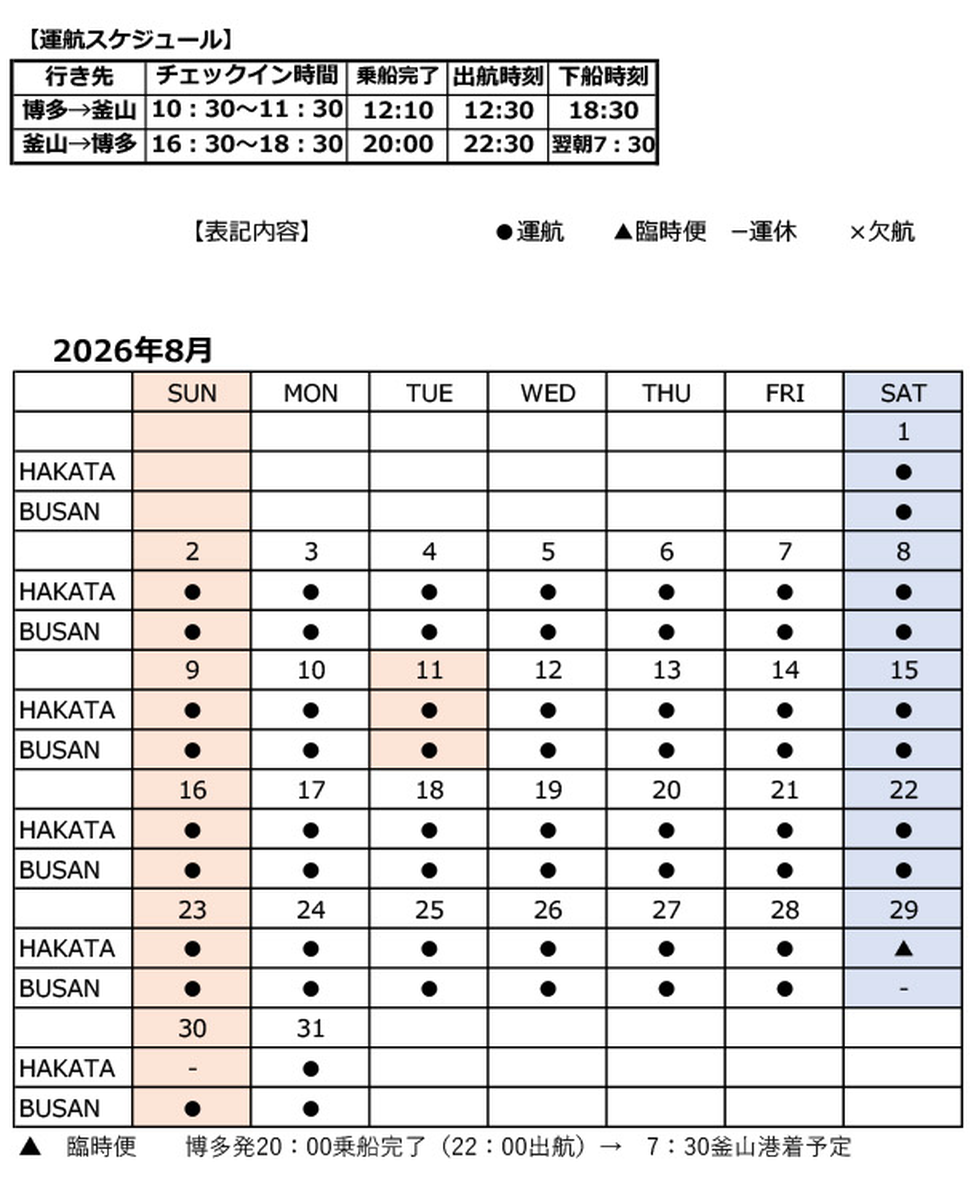
I pulled the operator’s Japanese sailing calendar for August–October 2026 on 9 August and counted the suspension marks. In that window there are five Saturdays with no Busan departure: 29 August, 5 and 12 September, 17 and 24 October. On each of those Saturdays Hakata runs an extra late sailing instead (departure 22:00, arriving Busan 07:30), and the following Sunday’s Hakata departure is cancelled in exchange.
On top of that there is an annual dry-dock. In 2026 the ship was out of service for fifteen days, 16–30 April, resuming with the Hakata departure of 1 May. Passenger enquiries were not answered during the shutdown either — the operator’s notice says so explicitly — so it is not a window in which you can phone to rearrange.
Local tip — The suspension dates are not published in English anywhere. They exist as a JPEG calendar on the operator’s Japanese site, with a legend (●運航 ▲臨時便 −運休 ×欠航) that you have to read to interpret. Before you commit to a date, open that calendar and check that your day carries a ● on the BUSAN row. Source: camellia-line.co.jp sailing calendar
calendar2608-10.jpg, checked 9 August 2026.
One more gap: as of the operator’s notice of 26 June 2026, the year-end schedule covering 26 December 2026 to 3 January 2027 had not been finalised and sales for some sailings were postponed. A New Year crossing is a date range to watch rather than book blind.
What it actually costs
Aggregators quote this route as one converted figure — “from $103,” “from 7,200 yen.” Neither matches what you pay. Port charges and a fuel surcharge are collected in cash at the counter, and both changed on 1 July 2026.
Base fares (effective 1 May 2025, unchanged as of August 2026):
| Cabin | One-way (KRW) | Round-trip (KRW) | One-way (JPY) |
|---|---|---|---|
| Special Suite (3 people) | ₩250,000 | ₩488,000 | ¥25,000 |
| Deluxe Single | ₩220,000 | ₩428,000 | ¥22,000 |
| Deluxe Twin | ₩200,000 | ₩388,000 | ¥20,000 |
| First Class (tatami or western) | ₩150,000 | ₩288,000 | ¥15,000 |
| Economy Bed | ₩135,000 | ₩258,000 | ¥13,500 |
| Economy | ₩120,000 | ₩228,000 | ¥12,000 |
Then the add-ons, which differ by which end you sail from:
| Charge | Leaving Busan | Leaving Hakata |
|---|---|---|
| Fuel surcharge | ₩17,000 | ¥1,700 |
| Harbour tax / terminal fee | ₩6,000 | ¥500 |
| Tourism promotion fund | ₩1,000 | — |
| Japan international tourist tax | — | ¥3,000 |
| Total added | ₩24,000 | ¥5,200 |
An Economy ticket out of Busan therefore costs ₩144,000 one-way, out of Hakata ¥17,200 (as of August 2026). Students under 30 and disability cardholders get 20% off the base fare but not the surcharges, and the discounts do not stack.
Local tip — The fuel surcharge from Busan rose from ₩9,000 to ₩17,000 and Japan’s international tourist tax from ¥1,000 to ¥3,000, both on 1 July 2026. I compared the operator’s three sites on 9 August 2026: only the Japanese fare page carries both new figures. The Korean site still lists the surcharge at ₩10,000 and the Japanese tax at ¥1,000, and the legacy Korean site still shows Economy at ₩90,000 — a 2023 price. If you budget from a Korean-language page you will be short about ₩30,000 at the counter. Source: camellia-line.co.jp/fare, koreaferry.com/user-guide and koreaferry.kr, all checked 9 August 2026.
The Japan tax change applies by ticketing date rather than sailing date, so tickets paid for before 1 July 2026 kept the old rate. Bring the surcharge money in cash — it is collected at the counter, not at booking. Our guide to using Korean ATMs as a foreigner covers which machines take foreign cards, cash or card in Korea explains where cards stop working, and what a week in Korea actually costs puts the fare in context.
Cabins: what you are actually booking
Ferryscanner states flatly that “cabins are not available” on this route. Every berth is in a cabin of some kind. What varies is whether it has beds.
| Grade | Sleeping | Rooms on board |
|---|---|---|
| Economy | Floor, shared open room | 24 |
| Economy Bed | Bunks | 2 |
| First Class tatami (5 people) | Floor, private room | 21 |
| First Class western (2 or 4 berth) | Beds | just over 30 combined |
| Deluxe single / twin | Beds | 4 each |
| Special Suite | Beds, balcony, bath | 2 |
Economy is a shared floor room holding 11 to 24 people, with a changing area and a TV and nothing else. Places are not assigned, so whoever boards early picks their spot. Lights go out at 23:00, half an hour after the ship sails.
Local tip — Economy Bed sounds like the obvious upgrade for anyone who does not want to sleep on a floor, and it is only ₩15,000 more. There are two of those rooms on the entire ship. The operator’s cabin page lists 보유객실 각 1실 — one room each in the 12-berth and 25-berth configurations — against 24 Economy rooms. If you want a bed and you are booking anywhere close to your travel date, First Class western is the realistic option, not Economy Bed. No English page I found gives the room counts at all. Source: koreaferry.com/cabin/economy-bed-cabin and /economy-cabin, checked 9 August 2026.
The Japanese fare page also sets out a room-charge table worth reading if you are travelling as a group: filling a four-berth First Class cabin with three people carries no supplement, while a solo traveller in a two-berth cabin pays roughly ¥3,000 extra (as of August 2026).
Baggage: there is no free checked allowance
Direct Ferries says one piece up to 30kg. Ferryscanner says 50kg. Others say free baggage is included. The actual rule is stricter: the free allowance is whatever you carry aboard yourself.
- Free, carried on: one item up to 30kg, three sides totalling 200cm or less, no single side over 90cm. You move it yourself.
- Checked, paid: ₩8,000 (¥800) up to 20kg, then ₩3,000 (¥300) per additional 10kg.
- Checked baggage desk: Busan 15:00–17:30, Hakata 10:30–11:30.
- Bicycles: ₩15,000 checked, ₩20,000 carried on, ₩25,000 for a tandem (rates from 1 October 2024). Electric bicycles are not carried at all.
The battery rules are stricter than most airlines’ and are posted in Korean only. Power banks up to 100Wh (27,000mAh) are limited to five and 100–160Wh (43,000mAh) to two; anything above 160Wh is refused. Batteries must stay on your person, not in a checked bag, and charging from the ship’s supply is not allowed. Electric scooters and e-boards are banned outright.
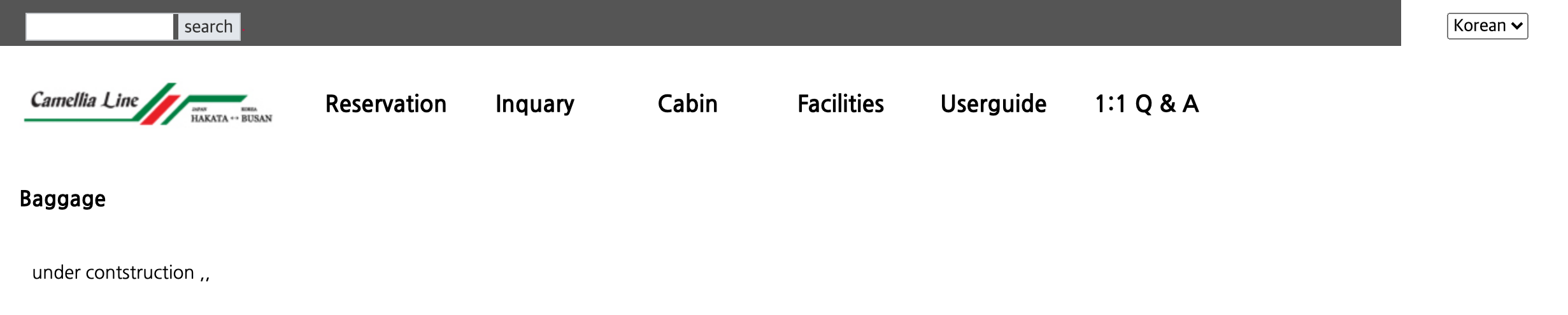
Local tip — I opened the operator’s English-language baggage page on 9 August 2026. The entire content of the page is the words
under contstruction ,,— typo included. The English site’s homepage, meanwhile, opens with two pop-up notices written entirely in Korean, one of them the battery restriction above. This is why the English aggregator figures diverge so wildly: there is no English source for them to copy from. Source: koreaferry.kr/eng, checked 9 August 2026.
Booking, and the rule that closes the window early
Bookings open six months ahead, on the same calendar day. Online booking then closes three days before departure — after that it is the reservation centre by phone (1688-7447 in Korea, 092-262-2323 in Japan) or a walk-up ticket. Online reservations must be paid immediately or they cancel themselves, and on a round-trip ticket you cannot cancel the outbound leg alone.
One recent change makes this route noticeably easier for foreign visitors. Until 11 June 2026 the discounted online fare required a membership account, which in practice meant Korean identity verification. At noon that day the operator scrapped membership entirely and replaced the member fare with an “internet discount fare” that needs no sign-up.
Cancellation charges on a walk-up ticket run ₩3,000 up to eight days out, 10% from seven to three days, 30% from two days until 18:00 on the day, and 100% after that. By phone you can cancel until 17:30 on the day, in person until 18:00, and weekend or holiday sailings must be cancelled by the previous weekday. Discounted online tickets carry a separate, steeper schedule — the operator says so itself and tells you to check before buying.
Getting to the two terminals
Busan Port International Passenger Terminal is at 206 Chungjang-daero, Dong-gu. From Busan Station, take Exit 10, follow the moving walkway onto the elevated pedestrian deck and walk 10–15 minutes. City buses 5-1, 42 and 172 run past for ₩1,550, route 1004 for ₩2,100 (as of 2026). From Gimhae Airport it is roughly 70 minutes by public transport, 30 by car.
Several English guides send you to Jungang Station instead. That is the old terminal’s neighbourhood — it moved in 2015. Mapping apps behave differently here than you expect, so see why Google Maps doesn’t work in Korea. Most travellers arrive from Seoul by train: read booking KTX tickets before you cut the connection fine, getting around Korea for the wider picture, and the T-money guide for Busan’s buses and subway.
Hakata Port International Terminal has the New Camellia ticket office on the second floor. A BRT articulated bus runs from outside the terminal to Hakata Station and Tenjin for around ¥230 in 20–40 minutes — that figure comes from Korean travel guides rather than an official source, so treat it as approximate. One thing worth checking before you sail: the terminal’s boarding bridge was out of service from May 2026, with temporary boarding and disembarkation arrangements in its place, and only returned to use with the morning arrival of 4 July 2026 — the Busan departure of the 3rd.
If you are staying in Busan the night before, the terminal’s location matters more than the view; where to stay in Busan sets out which neighbourhoods actually connect to Busan Station. With a late-evening sailing you have most of a day free — Busan’s attractions, the city’s beaches and Jagalchi and Gukje markets are all reachable and back in time for a 16:30 check-in.
Onboard: a 110-volt, yen-only ship
The New Camellia carries 522 passengers across three passenger decks. What surprises people is not the facilities list — bath, restaurant, karaoke, game room, duty free — but the operating details behind it.
- The onboard voltage is 110V. Neither a Korean 220V plug nor a Japanese 100V one is a straight match, and the operator flags “110V 변환 어댑터 필요” on every cabin page.
- Vending machines, coin lockers and the game room take Japanese yen cash only. If you board at Busan without yen, you cannot buy a drink on the ship.
- The public bath on deck 3 is free but has no towels. Shampoo, body wash and dryers are provided; bring your own towel.
- The restaurant serves breakfast and dinner only — there is no lunch service. Meal tickets come from a machine at the entrance.
- The information desk runs 19:00–22:30 on the Busan departure; the lounge and game room stay open around the clock, and the whole ship is non-smoking.
All of that comes from the operator’s Korean-language FAQ and cabin pages, checked on 9 August 2026. English pages list the same facilities without a word about currency, voltage or towels. Mobile coverage also drops out mid-crossing — Korea’s eSIM and SIM options covers what happens to a Korean data plan once you leave.
What happened to the Queen Beetle
JR Kyushu’s Queen Beetle did Busan to Hakata in under four hours. It has not run since August 2024, and it is not coming back.
The chain of events is documented in Korean and Japanese reporting: a hull crack caused flooding in February 2024, the flooding was concealed while the vessel kept sailing, Japan’s transport ministry uncovered it in August 2024 and the service was suspended. On 23 December 2024 JR Kyushu closed the high-speed ferry business permanently. In April 2025 the vessel was sold to the Korean operator PanStar, with a contractual condition barring it from Korea–Japan routes.
The ship is still sailing — just not internationally. In December 2025 PanStar put a 2,582-tonne, 83.5-metre trimaran into service as the PanStar Grace, a coastal sightseeing vessel working out of Busan’s domestic passenger terminal, and it was still running themed cruises through 2026. PanStar’s own announcement does not use the words “former Queen Beetle”; the identity is traced through the April 2025 sale reporting and the matching Austal-built trimaran specifications, so treat it as well-supported rather than officially confirmed.
To be fair to the English guides, the major ones have already corrected the closure — Direct Ferries’ Queen Beetle page reads “no longer available.” What is missing in English is where the ship went, and the fact that its return is contractually blocked rather than merely unlikely. If you find a booking page still selling Queen Beetle tickets, that is the thing worth knowing.
Cars, motorcycles and bicycles
Direct Ferries states that “ferry operators currently do not allow cars on sailings between Busan and Hakata.” The operator runs a full vehicle service.
It is a temporary export-and-return arrangement for tourism, restricted to vehicles owned by you or a family member — nine-seaters and small vans, no company cars or rentals. Booking runs from two months to ten days ahead, by phone only (051-410-7807), and you need your passport, the vehicle registration, an English-language registration certificate and an international driving permit, plus a power of attorney and family relationship documents if the car is in a relative’s name. The operator flags one line in bold on that list — 출국 당일 원본 지참 필수, originals on the day of departure. Copies are not accepted, and this is the point at which a vehicle booking most often falls apart at the counter.
Round-trip rates run ₩500,000 for 1,000–1,500kg up to ₩800,000 above 3,500kg, and ₩400,000 or ₩500,000 for motorcycles under or over 300cc (as of 2026). Same-day processing closes at 15:00 for campervans and 16:00 for cars and motorcycles. The car must be empty of belongings and the wheels washed clean of mud — there is a fine for turning up muddy.
When the crossing is cancelled
Cancellation is decided on wave height against the operating threshold, and the call usually comes the afternoon before — on 2 March 2026 the notice went up at 13:30 and cancelled both directions for 3 March.
The part nobody writes about in English: the notice comes with a downloadable cancellation certificate (결항증명서) attached as a PDF in Korean and Japanese. It is the document a travel insurer or a hotel wants when you ask them to waive a no-show, and it is sitting on the notice board rather than something you have to email and request. English coverage of this route records the frustration of short-notice cancellations but never the certificate. During typhoon season the Japanese site posts advance warnings in Japanese, Korean and English together.
Entering and leaving by sea
The formalities match an airport, with two wrinkles. Coming into Korea you complete the e-Arrival Card, and the operator posted a guide in April 2026 — in Japanese only — because passengers could not work out what to enter in the vessel-number field. That notice also states that Busan Port was still accepting paper arrival declarations, with no end date announced.
Whether you need a K-ETA depends on your nationality and changes yearly; our K-ETA guide and the Korea visa guide cover the current position, and both matter here because a ferry trip to Japan means re-entering Korea afterwards. Leaving by sea is still a departure for tax purposes — the VAT refund guide explains the instant-refund route, but a ferry terminal is not Incheon, so allow time.
Two rules catch families out. Middle and high school students travelling alone need a guardian’s consent form, submitted at the counter on the day of sailing; primary school children cannot sail unaccompanied even with one.
Pregnant passengers must declare the pregnancy when booking, whatever the stage, and complete a consent form. From 32 weeks the operator will not carry you at all. Before 32 weeks you travel as any other passenger unless a doctor has advised against sea travel — but you need a doctor’s certificate and a signed waiver, handed to the counter on the day you sail rather than sent in advance. The reason the operator gives is blunt: there is no doctor or nurse on board.
What You Need to Know
- Check-in closes at 18:30 for a 22:30 departure. The baggage desk closes at 17:30. Arriving between 16:30 and 17:00 works in every version of the timetable.
- “Daily” has exceptions published only as a Japanese JPEG. Five Saturdays between August and October 2026 have no Busan departure, plus a fifteen-day dry-dock each spring.
- The ticket price is not the total. Add ₩24,000 out of Busan or ¥5,200 out of Hakata, in cash at the counter (as of August 2026). Only the Japanese-language pages carry the July 2026 figures.
- There are two Economy Bed cabins on the whole ship. Assume they are taken.
- There is no free checked baggage. Free means what you can carry: 30kg, 200cm total, no side over 90cm.
- Cars and motorcycles are carried, contrary to the biggest English booking site — but by phone only, ten days out at the latest.
Practical Tips
- Be at the Busan counter by 17:00, earlier if you are checking a bag. The baggage desk shuts at 17:30, the ticket counter at 18:30. This is the instruction that matters most on this route.
- Check your date on the Japanese sailing calendar before booking anything else. Look for a ● on the BUSAN row; a − means no sailing.
- Book online more than three days ahead. After that you drop back to phone booking or a walk-up ticket. Since 11 June 2026 the discounted online fare no longer needs a membership account.
- Bring the port charges in cash — ₩24,000 per person leaving Busan, paid at the counter, not at booking.
- Withdraw yen before you board. The vending machines, lockers and game room take yen cash only, and there is nowhere on the ship to change money.
- Pack a towel and a 110V adapter in your carry-on. The bath supplies everything except a towel, and neither a Korean nor a Japanese plug fits the cabin sockets.
- Take the Busan-to-Hakata direction if you can choose. You sleep through the crossing and start at 07:30 with a full day in Fukuoka. The reverse leg burns daylight.
Frequently Asked Questions
Is there still a fast ferry from Busan to Fukuoka?
No. JR Kyushu’s Queen Beetle hydrofoil, which crossed in under four hours, was suspended in August 2024 after a concealed hull crack and flooding, and the business closed permanently that December. The vessel was sold to PanStar in April 2025 on the condition that it never return to Korea–Japan routes, and since December 2025 it has run coastal cruises out of Busan as the PanStar Grace. The overnight New Camellia is the only passenger service left.
How long does the Busan to Fukuoka ferry take?
The Busan departure is at 22:30 and disembarkation at Hakata begins at 07:30 the next morning — nine hours door to door on the timetable. The daytime Hakata-to-Busan leg runs 12:30 to 18:30, six hours. English aggregators list 10 to 12 hours, which appears to be measured from the 20:00 boarding deadline rather than the sailing time.
What time do I need to be at Busan Port for the Fukuoka ferry?
Check-in runs 16:30–18:30 on the operator’s Japanese calendar and its legacy Korean page; its current Korean page says 19:00. Checked baggage is accepted 15:00–17:30 and boarding must be complete by 20:00. Arriving between 16:30 and 17:00 satisfies every version. The 60–90 minutes quoted by English booking sites would put you there after the counter closes.
How much luggage can I bring on the Busan–Fukuoka ferry?
There is no free checked allowance. Free means what you carry yourself: one item up to 30kg, three sides totalling 200cm or less, no side over 90cm. Anything checked is a paid parcel at ₩8,000 (¥800) for the first 20kg and ₩3,000 (¥300) per further 10kg, and the desk closes at 17:30 in Busan. Power banks over 160Wh are refused entirely.
Does the Camellia ferry have real beds, or do you sleep on the floor?
Both exist. Economy, the cheapest grade, is a shared open room where you sleep on the floor with 11 to 24 others, unassigned, lights out at 23:00. Economy Bed has bunks but there are only two such rooms on the ship. First Class western cabins are the realistic bed option, at ₩150,000 one-way against ₩120,000 for Economy (as of August 2026).
How much does the ferry cost in total, including taxes and surcharges?
An Economy ticket from Busan is ₩120,000 plus a ₩17,000 fuel surcharge, ₩6,000 harbour tax and ₩1,000 tourism fund — ₩144,000 one-way (as of August 2026). From Hakata it is ¥12,000 plus ¥1,700 fuel, ¥3,000 Japanese tourist tax and a ¥500 terminal fee, so ¥17,200. The surcharges rose on 1 July 2026 and the Korean-language fare page still showed the old figures on 9 August 2026.
What happens if the ferry is cancelled because of the weather?
Cancellation is decided against a wave-height threshold, usually announced the previous afternoon on the operator’s notice board. The notice comes with a downloadable cancellation certificate (결항증명서) in Korean and Japanese, which insurers and hotels generally accept as proof. During typhoon season the Japanese site posts advance warnings in Japanese, Korean and English.
Related Questions
- Where to Stay in Busan: The Subway Access Nobody Warns You About
- Getting Around Korea: The Transport Guide That Connects the Details
- Do You Need a K-ETA for Korea? And Should You Get One Anyway?